
From Torque to Tech: Your Powertrain Playbook
This page is your one-stop shop for understanding the system that powers your vehicle. Here, you’ll find clear examples of electric vehicle (EV) and hybrid fundamentals, performance, and range insights, as well as battery technology and how powertrains deliver efficiency. Each section breaks down complex topics into simple, practical information to help you shop, compare, and drive with confidence.
Supercharge Your Knowledge
1. What is a powertrain?
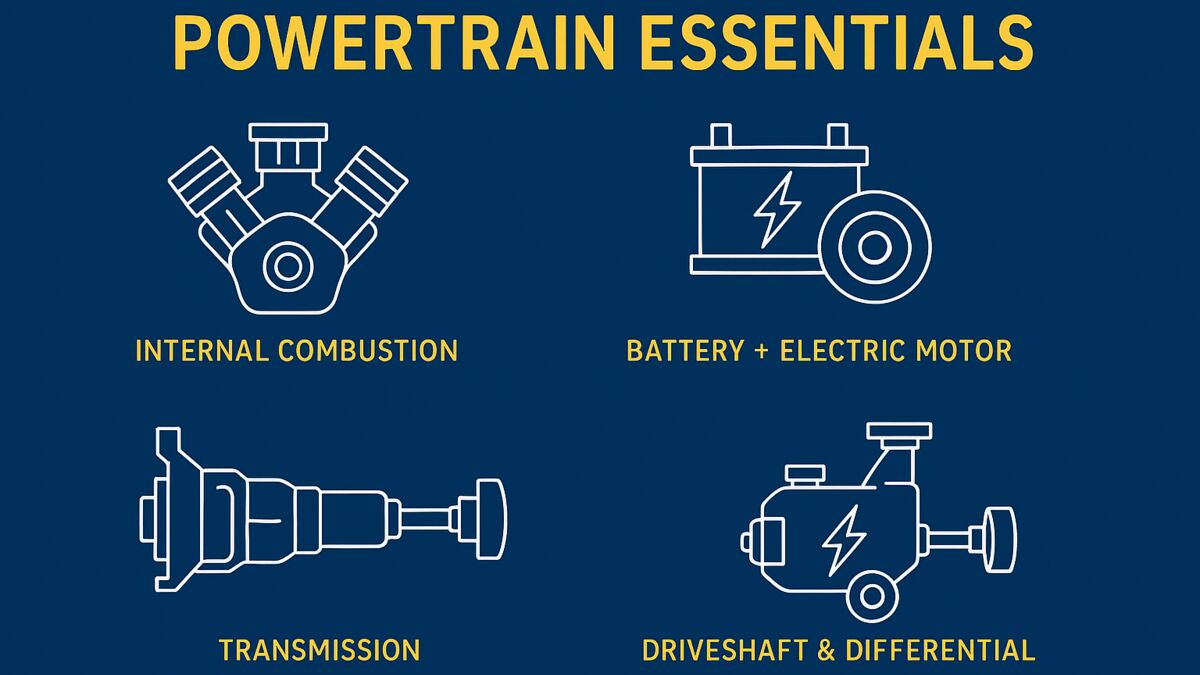
The powertrain is the system that creates power and delivers it to the wheels.
Gas vehicles: engine, transmission, drivetrain components, differentials, and axles.
Electric vehicles (EVs): electric engine(s), battery pack, inverter, power electronics, and a reduction gear.
2. AWD vs. 4WD: What’s the difference?
All-wheel drive (AWD) directs power automatically to all four wheels as conditions require, making it well-suited for everyday driving in rain, snow, or mild off-road conditions.
Four-Wheel Drive (4WD) is driver-engaged and intended for off-road use, towing, and low-speed control. Many 4WD systems include a low-range mode (4L) for steep or rough terrain.
3. Horsepower vs. torque: Which is more important?
The importance of torque and hp is entirely dependent on what you’re doing. Torque’s importance lies more in providing a quick start and low-speed acceleration, while hp’s importance is in maintaining speed and delivering peak performance at higher speeds. Engineers strike a balance between the two, rather than prioritizing one over the other.
4. Hybrid vs. plug-in hybrid: How are they different?
A hybrid vehicle (HEV) uses a gas engine and an electric motor powered by a small battery that recharges through regenerative braking and engine operation. Regenerative braking captures energy that would otherwise be lost during braking by utilizing the electric motor as a generator. Hybrids do not plug in.
A plug-in hybrid(PHEV) has a larger battery that can be charged from an outlet, allowing for longer all-electric driving before operating like a regular hybrid.
5. What is MPGe?
“MPGe” stands for “miles per gallon equivalent,” a calculated figure that indicates how efficiently an electric-powered vehicle uses energy relative to a gasoline-powered vehicle. MPGe numbers let consumers compare EV efficiency with traditional fuel-economy ratings. Real-world costs often depend on electricity prices and driving conditions.