

Quick Facts About New Car Prices
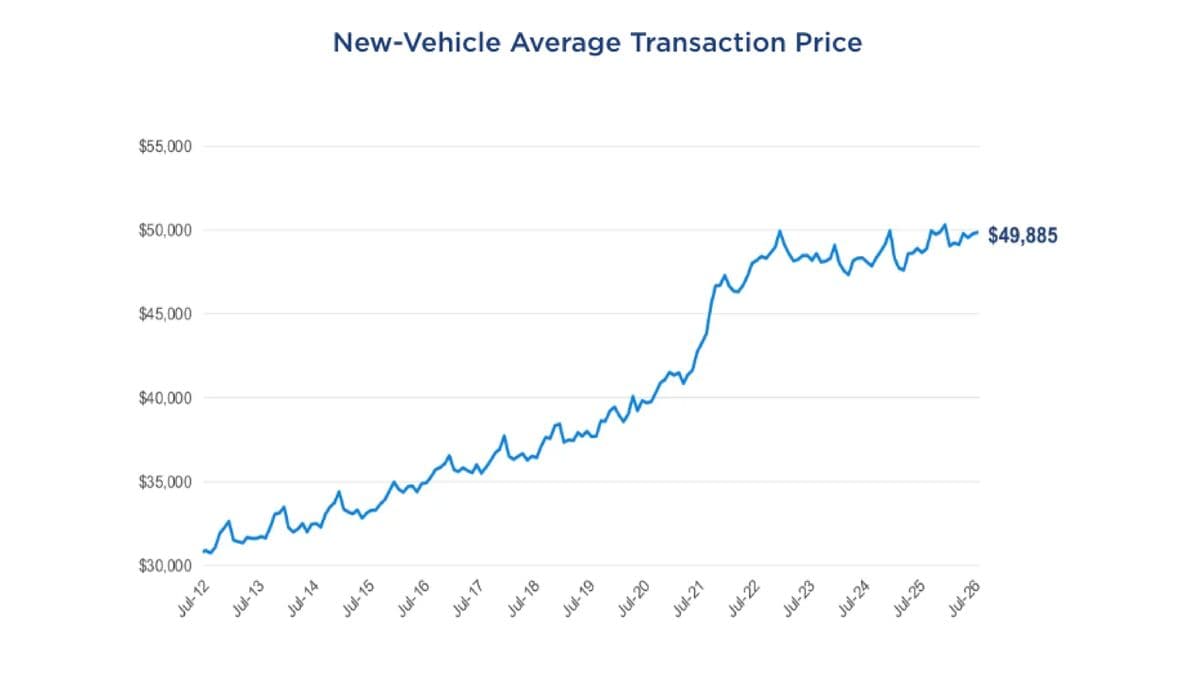
- The new vehicle average transaction price (ATP) in July was $49,855, up 0.2% from June and 1.9% higher than one year earlier.
- We continue to see restrained incentive spending and relatively balanced inventory levels.
- Prices continue to rise moderately year over year, but have stayed fairly flat throughout 2026. With the current market demonstrating ongoing restraint, waiting for prices to drop may be to your detriment. If you need a new car, consider adjusting your budget to fit this market.
The average transaction price (ATP) for a new vehicle in July 2026 was $49,855. This represented a very modest 0.2% increase from June and a 1.9% year-over-year increase. Model year 2027 vehicles are beginning to hit lots, but gradually. In July, 2027 model year vehicles increased to 5.6% of available inventory, which is well behind last year’s pace. This suggests that automakers are introducing new inventory at a more measured pace, and the new vehicle market is showing increasing balance.
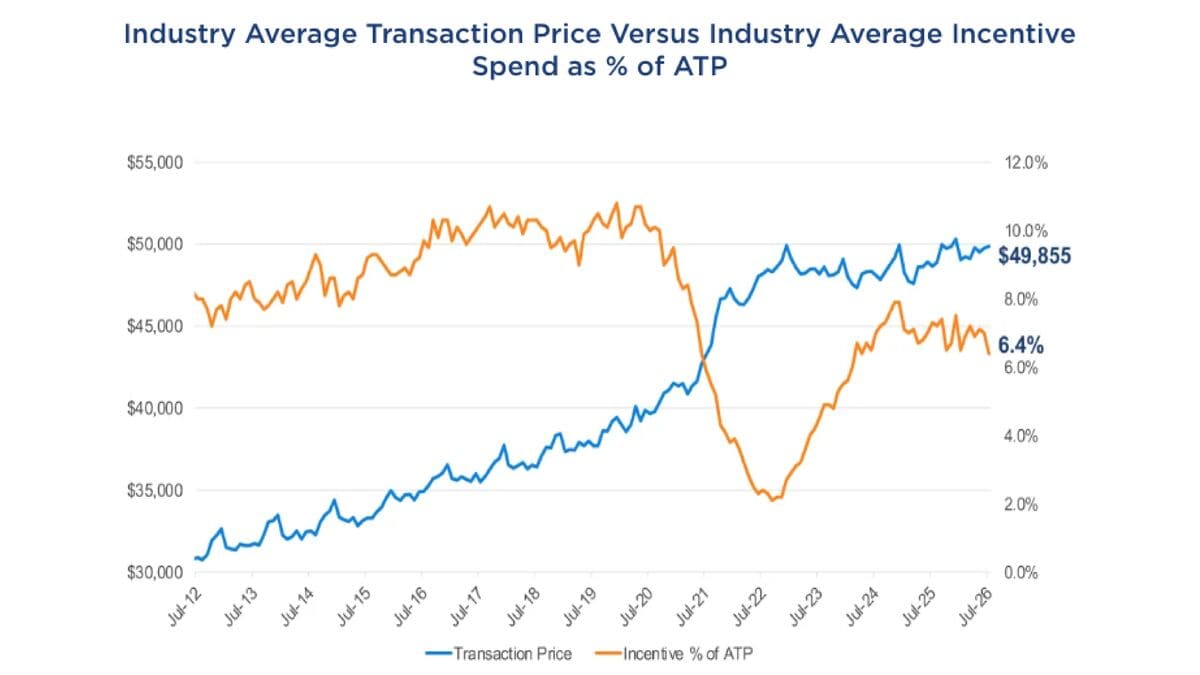
While this doesn’t translate to lower prices, it does suggest that we’ll continue to see steady prices. So while affording a new car isn’t any easier for the average buyer, we’re not currently looking at a landscape of continuing sharp increases. This means that if you need a new car right now, it’s as good a time to buy as any in this market. Careful shoppers may still find some good deals, but incentive spending in July did decrease to 6.4% of ATP, down slightly from June’s 7%. Manufacturers are showing discipline in incentive spending, though incentives remain elevated for full-size pickups, compact SUVs, and midsize SUVs. If you’re shopping in those segments, you might have some luck.
Read on for expert insights into what’s driving these trends and what you need to know if you’re planning to start your search or buy a car now.
- Where New Car Prices Stand
- The State of Electric
- New Car Inventory Update
- Shop Around for the Best Offer on Your Trade-in
- What to Expect: Looking Ahead
New Car Prices Stayed Steady in July
The new vehicle ATP in July was up just 0.2% from June. July’s $49,855 ATP was up 1.9% year over year, but has remained below $50,000 for all of 2026. Recent ATPs peaked at $50,609 in December 2025, a month when prices commonly peak due to a high mix of luxury-vehicle sales.
Because ATP is only an average, it can be helpful to look at segment-specific ATPs to better understand prices in the segment where you are shopping:
- Midsize SUV: $50,144, up 2.4% year over year
- Compact SUV: $37,745, up 2.7% year over year
- Full-size pickup truck: $66,980, up 2.8% year over year
- Subcompact SUV: $31,052, up 1.1% year over year
- Compact car: $27,904, up 2.6% year over year
“While incentive spending eased in July, that’s only part of the pricing story,” said Cox Automotive Executive Analyst Erin Keating. “We’re also seeing more 2027 model-year vehicles arrive on dealer lots, bringing fresh content, feature updates, and higher sticker prices into the market. Consumers continue to gravitate toward more affordable segments, which is helping keep overall transaction price growth in check, but the steady flow of newer vehicles is providing some upward pressure on both ATPs and MSRPs.” Cox Automotive is Kelley Blue Book’s parent company.
While all segments are showing ATP increases, a good sales mix is helping to keep industry-average prices steady. Midsize cars, compact cars, and subcompact SUVs continue to have the lowest listing prices and are still seeing year-over-year sales gains. Full-size pickups and full-size SUVs are showing comparatively softer sales.
New-vehicle sales in July were down 1.5% year over year and mostly flat compared with June, as the market slowed and buyers continued to migrate to lower-priced vehicles. Throughout 2026, we’ve continued to see restrained incentive spending among automakers. Incentive spending declined again in July for the second consecutive month, dipping to 6.4% of ATP — its lowest point since January. However, spending remains elevated in some best-selling segments, including full-size pickups (8.6%), compact SUVs (7.8%), and midsize SUVs (6.8%).
With ongoing conflict in the Middle East and rising economic pressure on the average household, the industry is keeping a close watch on consumer sentiment. “Heading into the fall selling season, the new-vehicle market appears increasingly balanced. Inventory remains near year-ago levels, pricing has been remarkably stable, and stronger demand is steadily working through available supply in many key segments,” said Keating. “While affordability remains a challenge for many households, vehicle prices have shown little upward movement and inventory levels continue to provide consumers a broad range of choices. At the same time, the slower-than-normal rollout of MY2027 vehicles suggests many automakers remain cautious about expanding inventory too aggressively. For now, sales momentum is proving strong enough to tighten market conditions without creating meaningful upward pressure on prices.”
Many buyers simply need a vehicle and cannot wait for international conflicts to end or economic conditions to improve. Explore Kelley Blue Book’s Car Affordability Information Center for curated articles designed to help you make smart, budget-friendly decisions.
MORE: Can I Afford a Car in 2026?
The Electric Landscape Sees a Modest Boost
New electric vehicle (EV) sales saw a 3.2% month-over-month boost in July, but were down 41.5% year over year. Sales totaled an estimated 77,226 units, accounting for 5.6% of total new vehicle sales. Tesla continued to dominate, with 42,435 units sold, increasing its market share to roughly 55%, up slightly from 54% in June. Rivian, Hyundai, Toyota, and Cadillac followed. Hyundai showed the largest month-over-month gains, with a 36% sales increase from June.
The average ATP for a new EV rose to $56,126 in July, up 1.2% from June and 1.6% year over year. Incentives averaged $6,626, or 11.8% of ATP, down from June’s 13.1%. Tesla’s Model 3 and Model Y had ATPs of $50,500 and $52,500, respectively. Higher-priced EVs, like the Kia EV9, Hyundai Ioniq 9, Cadillac Lyriq, Cadillac Optiq, and several luxury models, combined with lower incentive spending, continue to drive the increase in ATP.
Inventory levels for new EVs decreased in July. Overall days’ supply fell to 80, down 6.2% from June. Inventory remains below year-earlier levels, down 1.7% year over year. Inventory levels vary widely by brand. Volkswagen showed the highest days’ supply among major brands at 147 days, followed by Porsche and Nissan. At the other end of the scale was Subaru with the leanest days’ supply at 46 days, followed by Hyundai and Lexus.
“As year-over-year comparisons continue to normalize following last year’s federal EV tax credit expiration, underlying market trends may become clearer,” said Cox Automotive Director of Industry Insights Stephanie Valdez Streaty. “Inventory remains generally aligned with demand, while declining incentives, evolving pricing dynamics, and growing used EV availability will be key indicators of market performance in the months ahead.”
What Drives New Car Prices
New car prices are not established by any single factor. They reflect a complex interplay among the following:
- Inventory availability
- Manufacturer incentives
- Dealer discounts
- Trade-in vehicle values
- Geopolitical shifts
When any one of these factors shifts, the others may adjust to accommodate the impact.
New Car Inventory Update
Dealerships track the number of new vehicles they have on hand using a metric called “days’ supply,” or how long it would take them to sell out at today’s sales pace if they stopped adding new vehicles. According to Cox Automotive’s vAuto Live Market View, new car inventory data for July showed 75 days’ supply, down from 82 days in June. This movement suggests that demand is absorbing inventory more quickly than it was earlier in 2026, and that the market is shifting toward a healthier balance. Total available inventory decreased to 2.73 million units in July, down 3.5% from June’s 2.82 million but roughly unchanged year over year.
“Stronger sales were particularly evident in several of the industry’s most important segments. Midsize SUVs posted one of the largest declines in days’ supply, falling nearly 14 days during the month, while full-size truck supply tightened by 10 days as sales rose nearly 16%,” said Keating. “Performance in these high-volume segments suggests consumer demand remained healthy despite affordability challenges and elevated vehicle prices.”
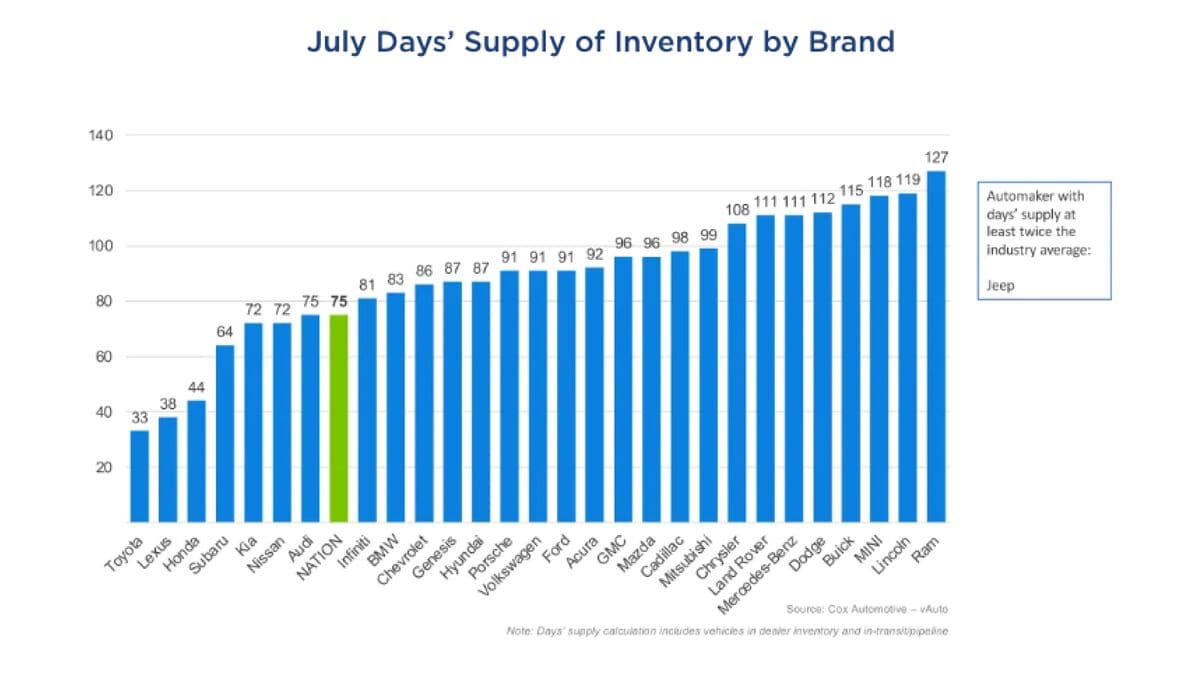
Different inventory strategies continue to show in results at the brand level. Toyota ended the month with the tightest inventory at 33 days’ supply, followed by Lexus and Honda. These three continue to operate with tight inventories, in somewhat stark contrast to the other end of the spectrum. Stellantis made progress in June with reducing its inventory, but Ram still finds itself sitting with a 127 days’ supply. Some automakers are focusing on matching production with demand and others are replenishing inventories as sales show improvements.
What does this mean for car shoppers? The 2026 market has demonstrated stability. However, while inventory levels look balanced overall, the distribution is certainly not even across all brands. Unfortunately, this isn’t helping consumers much. Even brands with high days’ supply continue to show restraint in incentive spending. That said, we did see some increased incentive spending in July for full-size pickups, compact SUVs, and mid-size SUVs. If you’re willing to shop around and consider a wider range of makes and models, there is potential to find a deal.
Shop Around for the Best Offer on Your Trade-in
Trade-in value is another factor driving car prices. A lack of used-vehicle stock has kept prices higher, giving credence to the idea that buying a new vehicle can sometimes be cheaper than purchasing a used model that’s only a few years old. As a result, it’s still a potentially good time to trade in your car.
Dealers value your trade-in partly based on what they need in stock, so if you have a popular model, you may be in luck. On the other hand, they may offer less or a model already plentiful on their lots. In other words, a buyer trading in a 2018 Honda Civic for something else may be much happier with the trade-in appraisal than a shopper trading in a 2021 Jeep Grand Cherokee.
Car buyers should prepare to shop around for the best trade-in offer. It requires another step, but selling your old vehicle to one dealership and buying your new car from another may make sense if the final numbers work in your favor. Use the Kelley Blue Book Instant Cash Offer tool to shop your trade-in vehicle at nearby dealerships. Comparing multiple bids makes it easier to choose the best trade-in offer. Remember, you can always negotiate the offer, and using one offer to counter another is not unheard of when shopping for a vehicle.
What to Expect: Looking Ahead
New-car inventory in July was down from June and mostly unchanged year over year. The U.S. market had 2.73 million new vehicles available, or about 75 days’ supply. This is still a notable decline from the roughly 90 days’ supply recorded in January and February, but year-over-year inventory has been relatively stable. The industry has shown resilience in the face of rising gas prices, uncertainty surrounding the war in the Middle East, and growing economic pressure at home.
For buyers, this means that while prices aren’t skyrocketing, they continue to rise very gradually. If you’ve been holding out in the hope that geopolitical uncertainty will ease, it may be time to consider that the trends seen throughout 2026 could persist. Options in lower-priced brands remain limited, though shoppers willing to consider different brands and models can still find incentives to help lighten the financial burden. We will continue monitoring the war’s effect on the market in the months ahead.
RELATED: Bad Credit Car Loans: Everything You Need to Know
What to Do if You Need a Car Now
Incentives are a buyer’s best friend in the current market. If you can adjust your expectations about the type of car or brand you are willing to buy, you may find good deals. Beyond that, prices remain on a steady, modest upward trend. Before buying:
- Research your options and expand your search if needed.
- Look for deals and incentives, especially on vehicles that dealers may be trying to sell to make room for newer models.
- Shop ahead for a car loan if you’re not paying cash.
Editor’s Note: We have updated this article since its initial publication.